
Top 10 PMS in India by 1-Month Return as of March 2026
Funds ranked by 1-month returns as of March 2026 highlight the top-performing Portfolio Management Services (PMS) in India. Explore the latest rankings, compare leading investment strategies, and understand the factors behind their performance to make more informed decisions when evaluating professionally managed portfolios.
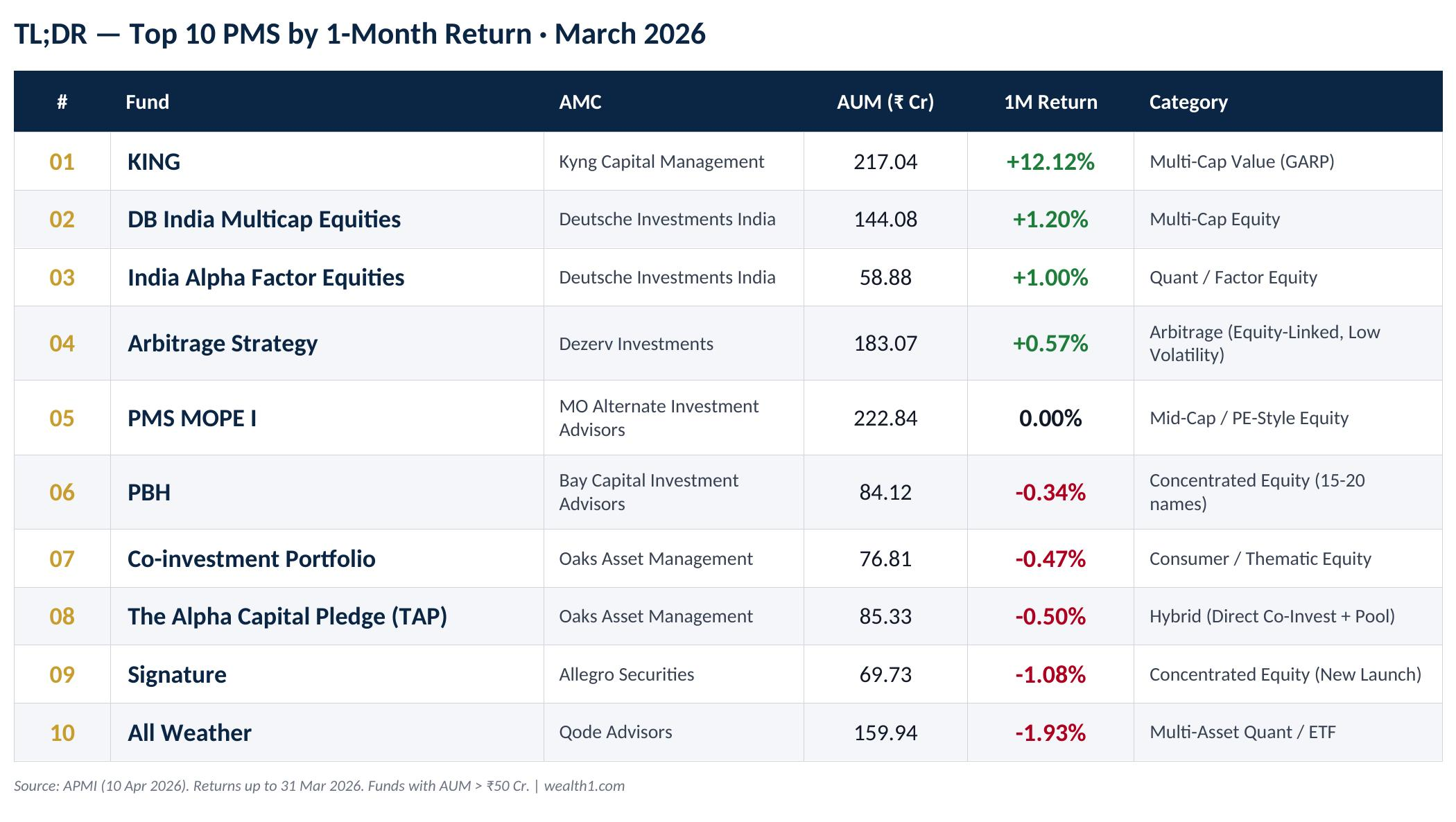
In a brutal March 2026 for Indian equities — Nifty down ~4-5%, IT in freefall, and crude surging on West Asia tensions — these 10 Portfolio Management Services (PMS) funds delivered the best 1-month returns.
Below: the full ranked list with AUM, category, strategy and returns across 1M, 6M, 1Y, 3Y, 5Y and Since Inception.
HOW THIS WAS BUILT
- Funds ranked by absolute 1-month return for March 2026.
- AUM filter: > ₹50 Cr. Source: APMI disclosures.
- Returns up to 1 year are absolute; longer-period returns are annualised using TWRR (Time-Weighted Rate of Return).
- NA = not applicable (fund too young for that bucket).
Market Context: Why March 2026 Mattered
March 2026 capped FY26's sharpest yearly equity decline since COVID. The Nifty slid ~4-5% in the month alone, driven by IT-sector selling, a weaker rupee, crude spiking on Iran-US tensions, and global rate-cut uncertainty. Most PMS schemes lost 7-15%. The funds below didn't - a mix of value, quant, arbitrage, mid-cap PE-style and multi-asset strategies that either preserved or grew capital.
The Top 10 PMS Funds, Ranked (Based on March 2026 Returns)
PMS RETURNS FOR KYNG KING CAPITAL PMS
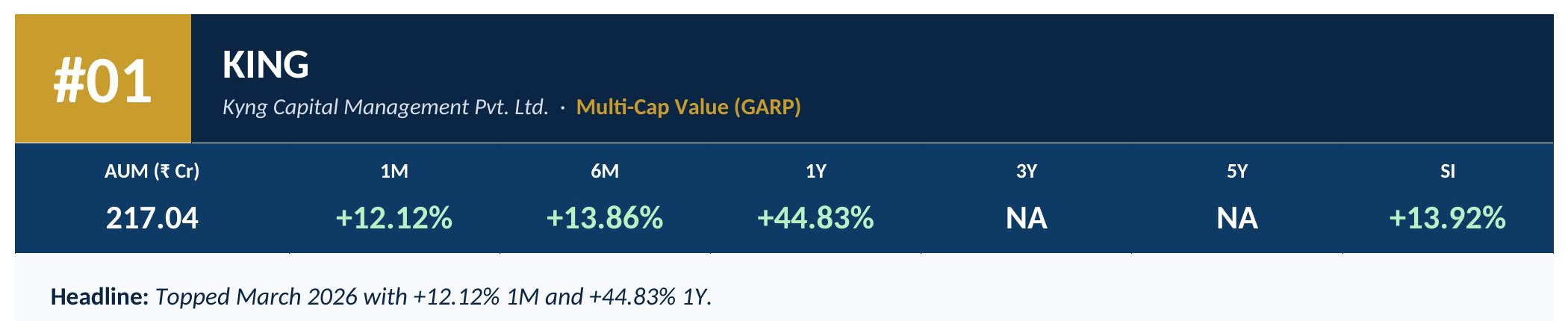
KING is a concentrated value PMS rooted in Graham-Buffett principles — GARP picks with economic moats and a clear margin of safety. Zero management fees; performance fees kick in only above 10% CAGR, so the manager eats only when investors do. Founded by Dr. Siddharth K J (ex-KAF Capital). On a ₹217 Cr book, that alignment delivered the single best 1-month return in the APMI March 2026 sheet.
Deutsche Bank PMS returns March 2026
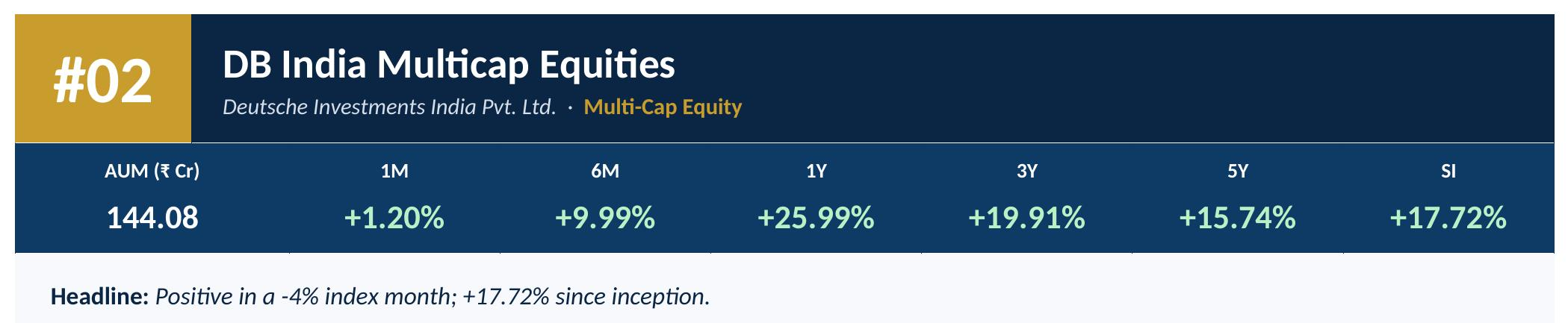
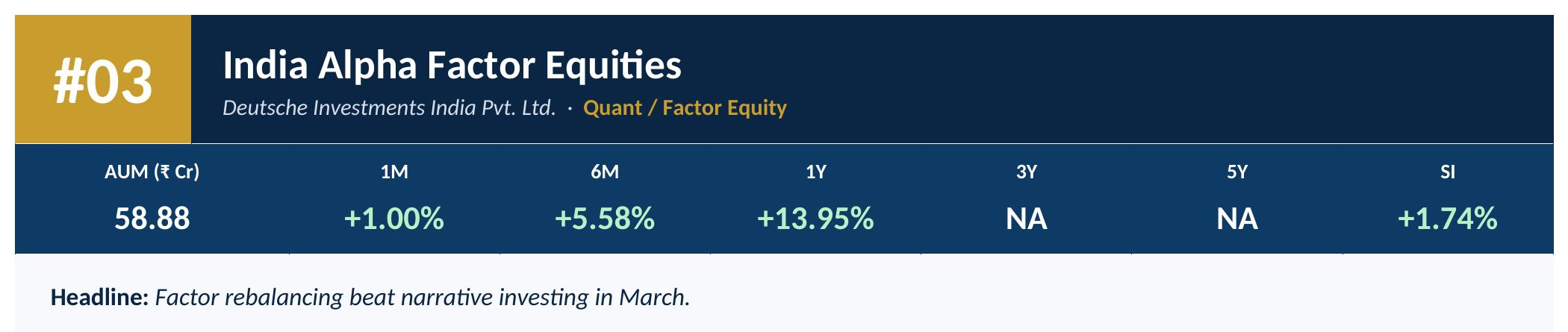
Deutsche Bank India's flagship multi-cap PMS blends top-down themes with bottom-up picking, targeting quality businesses that can fund their own growth through internal cash. Held +1.20% in March while the Nifty cracked 4-5%. The real story is consistency: +25.99% 1Y, +19.91% 3Y, +17.72% SI — institutional-grade discipline across cycles.
Dezerv PMS March returns 2026
Dezerv PMS March returns 2026
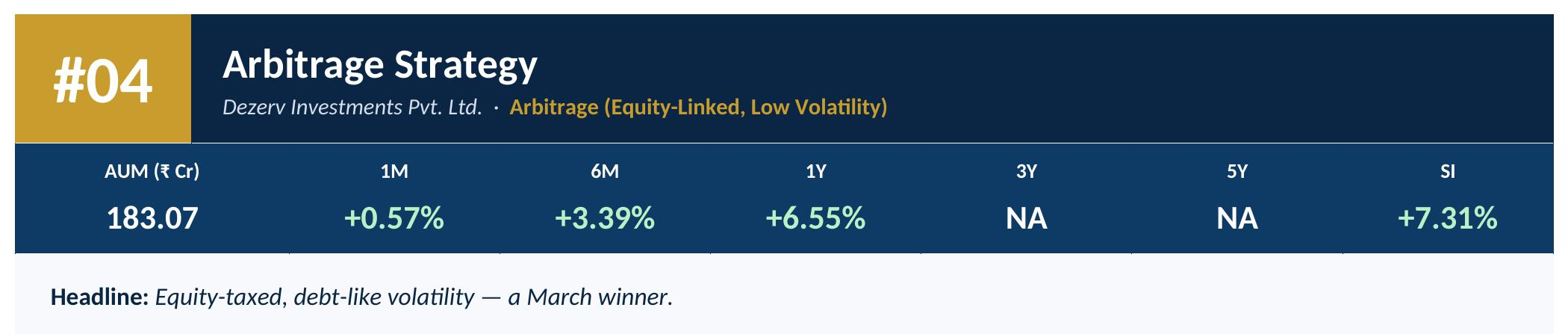
Managed by Kumarpal Jain (CFA), Dezerv's arbitrage PMS exploits price differentials rather than directional bets. Delivered +0.57% 1M and +7.31% SI while equity PMS took a beating. For HNI investors who want equity-taxation benefits with bond-like drawdown, March 2026 was the month this product proved its thesis.
Motilal Oswal PMS Returns March 2026
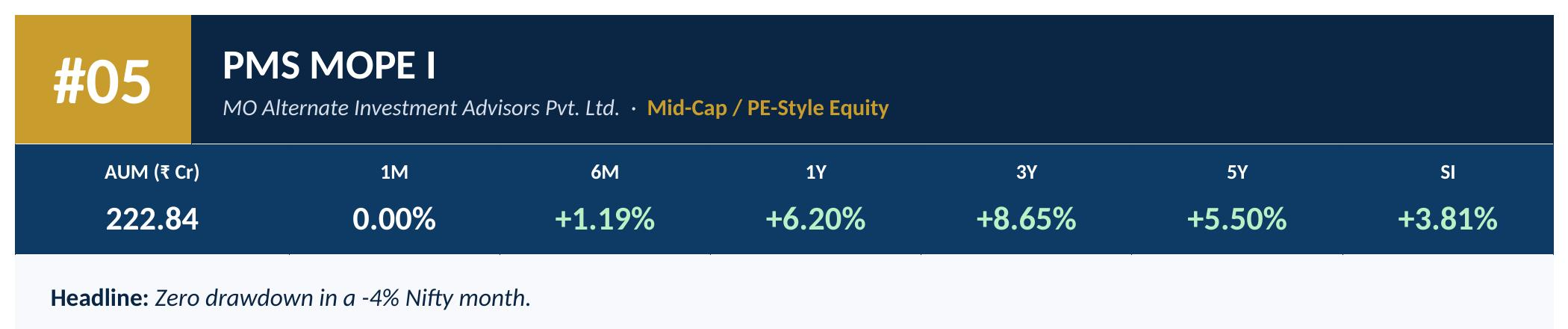
Motilal Oswal Alternates' mid-market PMS built on the QGLP framework — Quality, Growth, Longevity, Price. The PE vertical has a 20-year, 50-investment track record with a ~5x gross MOIC and 26% gross IRR. Returned 0.00% in March when the index dropped 4-5% — the textbook definition of capital preservation in action.
Bay Capital PMS Returns March 2026
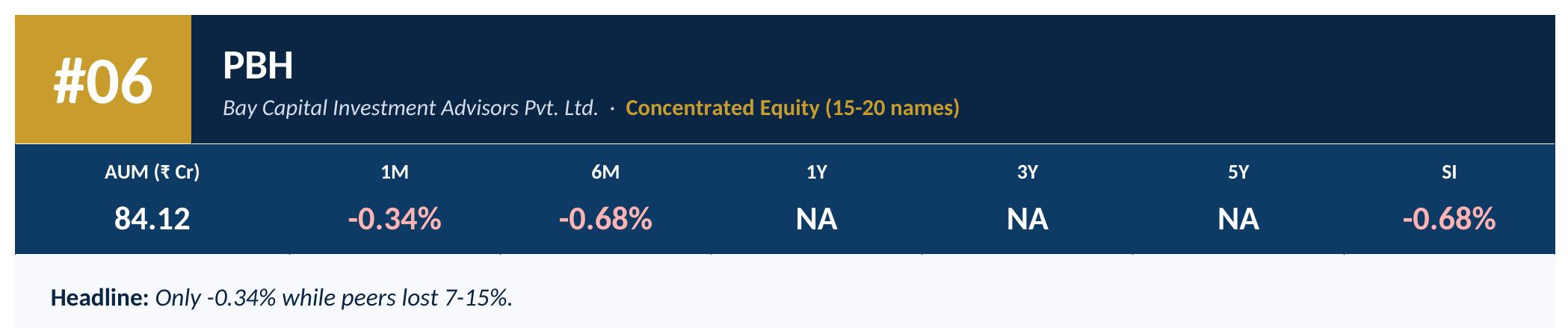
Bay Capital (est. 2006) runs a concentrated 15-20 stock book led by Nikunj Doshi (34+ years in markets). The PBH mandate is new, but its March showing — down just -0.34% against a 4-5% index fall — is exactly what high-conviction, low-churn equity portfolios are designed to deliver.
Oaks PMS Returns March 2026
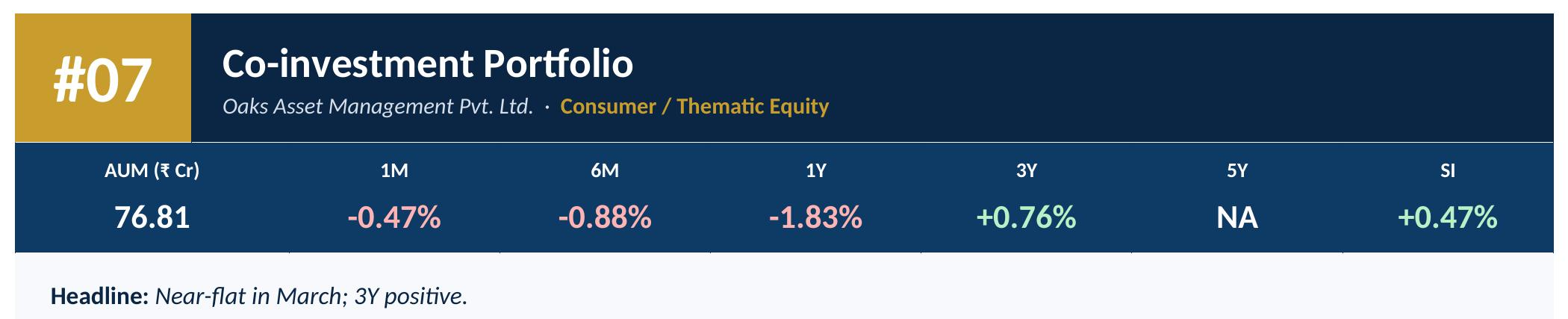
Oaks (est. 2015) backs scalable consumer businesses led by proven entrepreneurs. The co-investment product lets investors ride alongside the firm's conviction plays on a ₹77 Cr book. Only -0.47% in March and +0.76% 3Y — a patience portfolio that tends to shine when retail is panicking.
Oaks PMS March 2026 Returns
Signature PMS March 2026 Returns
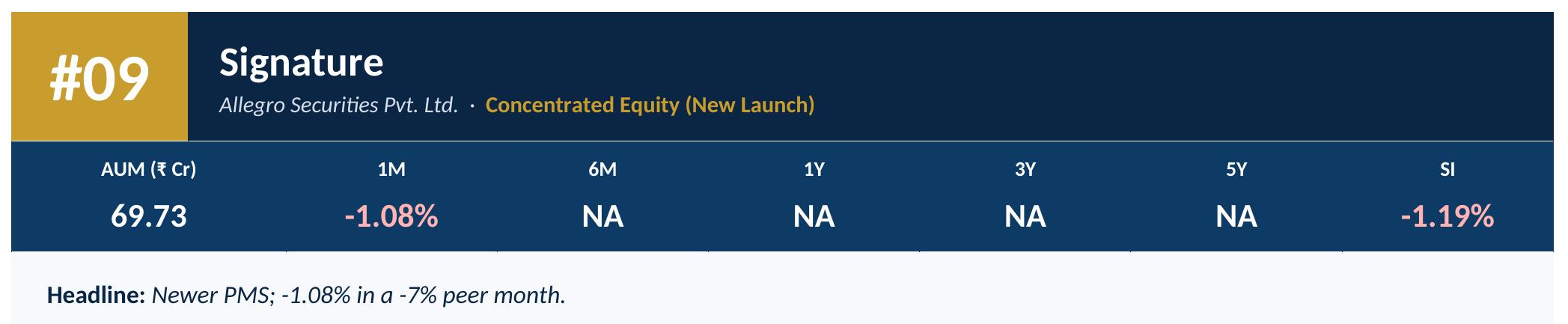
A newer entrant with limited history on the APMI sheet (SI: -1.19%). In a month where peers lost 7-15%, Signature's -1.08% is a quiet win. Small, concentrated, and optimised for downside control — early data suggests a manager focused on drawdown management, not index-timing.
March 2026 demonstrated that not all PMS strategies react the same way during periods of market stress. While most portfolios struggled amid a sharp equity correction, the funds featured in this ranking showed relatively stronger resilience through disciplined investment processes, diversified approaches, and effective risk management. Although these strategies delivered the best 1-month returns for the period, investors should avoid making decisions based solely on short-term performance. Evaluating a PMS strategy over longer time horizons, along with its investment philosophy, consistency, risk profile, and suitability for individual financial goals, remains essential before investing.
QODE All Weather PMS Returns March 2026
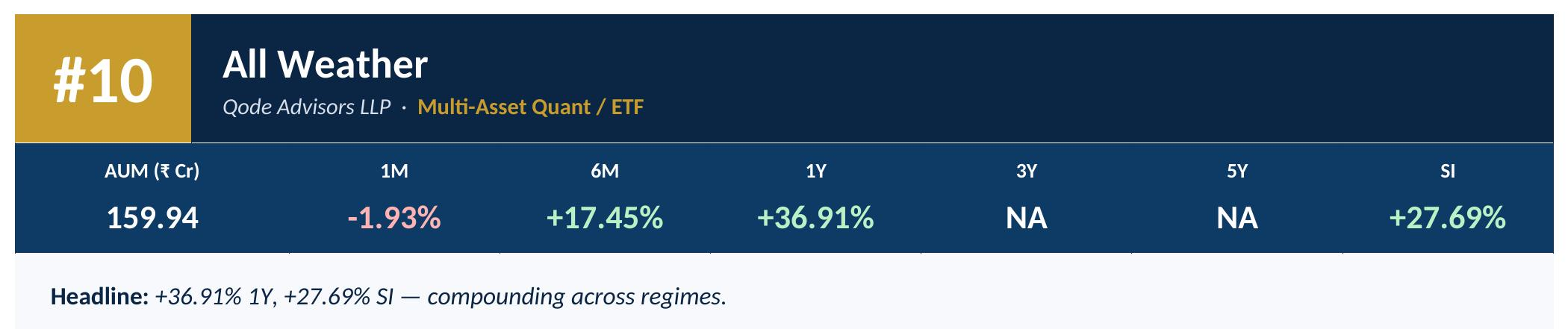
Built by co-founder Rishabh Nahar, All Weather is a quantitative ETF strategy tilted toward low-correlated sleeves — momentum, low-volatility, gold. Look past the -1.93% March tick: +17.45% 6M, +36.91% 1Y, +27.69% SI. In an FY shaped by Iran-US tensions, oil shocks and IT selloffs, systematic multi-asset has had its moment.
Key Takeaways
- Diversified strategies dominated the top rankings, highlighting the value of balanced portfolios during volatile market conditions.
- Focused portfolios backed by disciplined investment processes helped limit drawdowns and preserve capital.
- Arbitrage and quantitative strategies performed well, benefiting from systematic and market-neutral approaches.
- Strong short-term returns do not necessarily indicate long-term success, making consistent performance and strategy equally important.