
Why the Current Macro Environment is the Best Case for PMS & AIF Allocation
India's favorable macroeconomic environment in 2026—with lower inflation, interest rate cuts, improving corporate earnings, and supportive fiscal policies—is creating strong opportunities for Portfolio Management Services (PMS) and Alternative Investment Funds (AIFs). Explore why active investment strategies are well-positioned to capitalize on this evolving market landscape and deliver long-term wealth creation.
India's macro landscape in early 2026 is arguably the most favourable it has been in half a decade for HNI investors evaluating Portfolio Management Services (PMS) and Alternative Investment Funds (AIFs). Low inflation, a rate-cut cycle, recovering earnings, a US-India trade deal, and a structurally disciplined fiscal policy have converged in a way that rewards concentrated, actively managed capital - exactly what PMS and AIF are designed to deliver.
This is not a generic optimism piece. At Wealth1, we track 450+ PMS strategies and 150+ AIF strategies independently. What we're describing here is a specific macro setup - and why it matters for how you should be thinking about your alternative allocation right now.
The Macro Setup: What Has Actually Changed
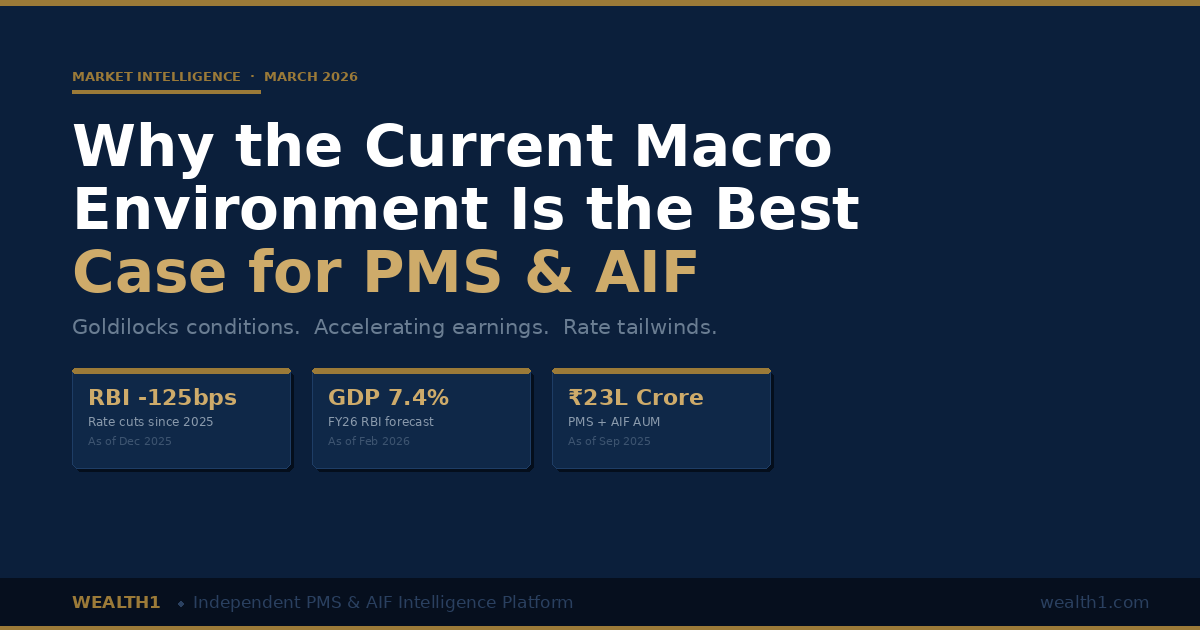
RBI has cut rates by 125 basis points since early 2025. The repo rate now sits at 5.25%, near its lowest level in four years. Inflation - which ran hot through much of 2022-24 has fallen sharply, with CPI staying below 2% in December 2025, well inside the RBI's 2–6% tolerance band. This is a genuine Goldilocks environment: growth is strong, inflation is soft, and the central bank has room to support the economy without triggering price pressure.
GDP growth remains above consensus. Goldman Sachs forecasts India's real GDP at 6.9% for 2026. The RBI's own revised forecast for FY26 is 7.4% - upgraded twice in the same fiscal year. Q1 FY26 came in at 7.8%, the fastest pace in seven quarters.
The earnings cycle is turning. After 15 months of sideways consolidation and muted single-digit earnings growth in 2025, corporate India is entering an earnings acceleration phase. Market analysts at Motilal Oswal and Tata Mutual Fund both project mid-double-digit earnings growth in 2026, driven by a triple catalyst: GST rationalisation, income tax relief, and interest rate transmission finally flowing through to corporate balance sheets.
The US-India trade deal has removed a key overhang. With US tariffs on Indian exports reduced to 18% - from a punishing 50% - a significant source of uncertainty has been lifted. This is expected to support private investment and export-led sectors, adding another dimension to the growth story.
What this means for HNI investors: the environment that punishes passive, index-heavy exposure - low earnings growth, high valuations, global uncertainty, is giving way to one that rewards active, high-conviction management. That is the precise environment where PMS and AIF earn their fee.
Why This Is Different From a Mutual Fund Moment
1.Mid and small-cap earnings are outpacing large caps
In 2025, midcap and small-cap earnings momentum was structurally stronger than large-cap benchmarks. Nifty 50's fair-value estimates suggest returns will be driven by earnings expansion, not multiple re-rating. This rewards concentrated stock-selection and bottom-up research - the core competency of a well-run PMS, not a passive fund.
2.Rate cuts directly expand the PMS opportunity set
Sectors most sensitive to the cost of capital - infrastructure, real estate, NBFCs, consumption - are now entering a rate tailwind. Infrastructure firms alone are projected to post 14% earnings CAGR through FY27, supported by the government's ₹12.2 trillion capital expenditure for FY27 in the union budget. A well-positioned PMS strategy captures this sectoral rotation precisely; a broad mutual fund dilutes it.
3.The AIF universe is maturing into India's private economy
Total AIF commitments have grown from ₹27,484 crore in 2015 to ₹15.05 lakh crore in September 2025 - a 49% CAGR over a decade. Private equity, structured credit, private real estate, and venture strategies are no longer exotic. They are how serious HNI portfolios access returns that are structurally unavailable in public markets.
The Size of the Shift: Where India's HNI Capital Is Going
According to SEBI and APMI data, PMS and AIF assets together exceeded ₹23 lakh crore in assets under management (AUM) by September 2025, growing at a combined 10-year CAGR of 31.24%.
PMS assets alone have almost doubled—from approximately ₹5 trillion in FY21 to ₹10.5 trillion by January 2026.
The number of investors has crossed 2.15 lakh, while SEBI-registered portfolio managers have increased from 361 to 501 during the same period.
PMS is no longer a niche investment product—it has become one of the primary vehicles through which India's HNI wealth is professionally managed.
However, not every PMS strategy delivers similar results.
With more than 450 PMS strategies available, the performance gap between top-performing and bottom-performing managers can exceed 15–20 percentage points annually over a three-year period.
This difference can significantly impact long-term wealth creation.
This is precisely the problem Wealth1 aims to solve.
What Independent Intelligence Actually Means in This Market
Many investors evaluating PMS or AIF products receive information that is influenced by distributor relationships or fund-house incentives.
Performance comparisons may be selective, fee disclosures incomplete, and risk-adjusted metrics often overlooked.
At Wealth1, every major PMS and AIF strategy is evaluated using the same framework, including:
- Benchmark performance
- Sharpe Ratio
- Sortino Ratio
- Maximum Drawdown
- Fee Structure
- AUM Growth
- Fund Manager Tenure
No fund house pays us to feature its products, and our comparisons remain completely independent.
In today's market, where macroeconomic tailwinds are favourable but performance differences remain significant, the quality of strategy selection matters more than ever.
Three Allocation Themes Worth Evaluating
Domestic Consumption and Credit Recovery
Lower interest rates and income tax relief are expected to improve consumer spending.
Consumption-focused PMS strategies with exposure to:
- Retail lending
- NBFCs
- Consumer discretionary
- Branded businesses
appear well-positioned for the next earnings cycle.
Infrastructure and Manufacturing
Government capital expenditure continues growing at approximately 11–12% annually, while Production Linked Incentive (PLI) schemes continue supporting manufacturing investments.
PMS strategies focused on industrials, capital goods, engineering, and construction businesses could benefit over the next 3–5 years.
Category II AIFs – Private Credit
Private credit continues to emerge as one of the strongest opportunities.
Well-structured Category II AIFs lending to mid-market companies currently target approximately 14–18% gross IRRs with relatively lower volatility.
For HNI investors comfortable with ₹1 crore minimum investments and multi-year lock-in periods, this remains one of today's strongest risk-adjusted opportunities.
A Note on Risk
No macroeconomic environment eliminates investment risk.
The RBI appears close to completing its rate-cut cycle, meaning future returns will increasingly depend on earnings growth rather than further monetary easing.
Foreign Institutional Investor (FII) flows also remain uncertain. Although domestic institutions have supported Indian markets, sustained foreign selling could still create volatility.
Finally, valuations remain reasonable—but not cheap.
With the Nifty trading around 21–21.5x forward earnings, active manager selection becomes increasingly important.
Conclusion
The macroeconomic environment in early 2026 presents one of the strongest backdrops for equity-oriented PMS and carefully selected AIF strategies since 2020.
Strong GDP growth, low inflation, lower interest rates, improving corporate earnings, and supportive government policies together create favourable conditions for active investment management.